
The discussion around a florida housing market crash has become one of the most debated topics in the United States real estate sector. Florida has long been considered one of the hottest property markets in the country, attracting millions of new residents, investors, retirees, and international buyers. However, rapid price increases, rising interest rates, insurance challenges, and affordability concerns have led many analysts to question whether the market is heading toward a correction or even a crash.
Understanding whether a true crash is happening—or whether the market is simply normalizing after years of explosive growth—requires a deep look at economic indicators, housing supply and demand, migration patterns, and investment behavior. This article breaks down the key signs, potential impacts, and risks surrounding the florida housing market crash debate in a clear and informative way.
What Does a Housing Market Crash Actually Mean?
A housing market crash refers to a sudden and significant decline in home prices across a region, often triggered by economic instability, oversupply of homes, rising unemployment, or financial system stress. In the context of a florida housing market crash, it would mean a sharp drop in property values across major cities like Miami, Orlando, Tampa, and Jacksonville.
Unlike a normal market correction, which is gradual and controlled, a crash is typically fast and severe. It can lead to negative equity for homeowners, reduced construction activity, and a slowdown in real estate investment.
However, it is important to distinguish between a crash and a cooling market. Florida has experienced rapid price appreciation in recent years, and some slowdown may simply reflect stabilization rather than collapse.
Why Florida’s Housing Market Became So Expensive
Before analyzing the possibility of a florida housing market crash, it is important to understand why prices rose so dramatically in the first place.
Florida has experienced massive population growth, driven by domestic migration from high-tax states like New York, California, and Illinois. Many people moved to Florida due to lower taxes, warm weather, and job opportunities.
At the same time, demand for vacation homes and investment properties increased significantly. Remote work trends also allowed more professionals to relocate without being tied to a physical office.
On the supply side, construction could not keep up with demand. Labor shortages, material costs, and zoning restrictions limited the number of new homes being built. This imbalance between supply and demand pushed prices upward rapidly.
As a result, Florida became one of the most competitive real estate markets in the United States, setting the stage for concerns about overheating.
Key Signs of a Florida Housing Market Crash
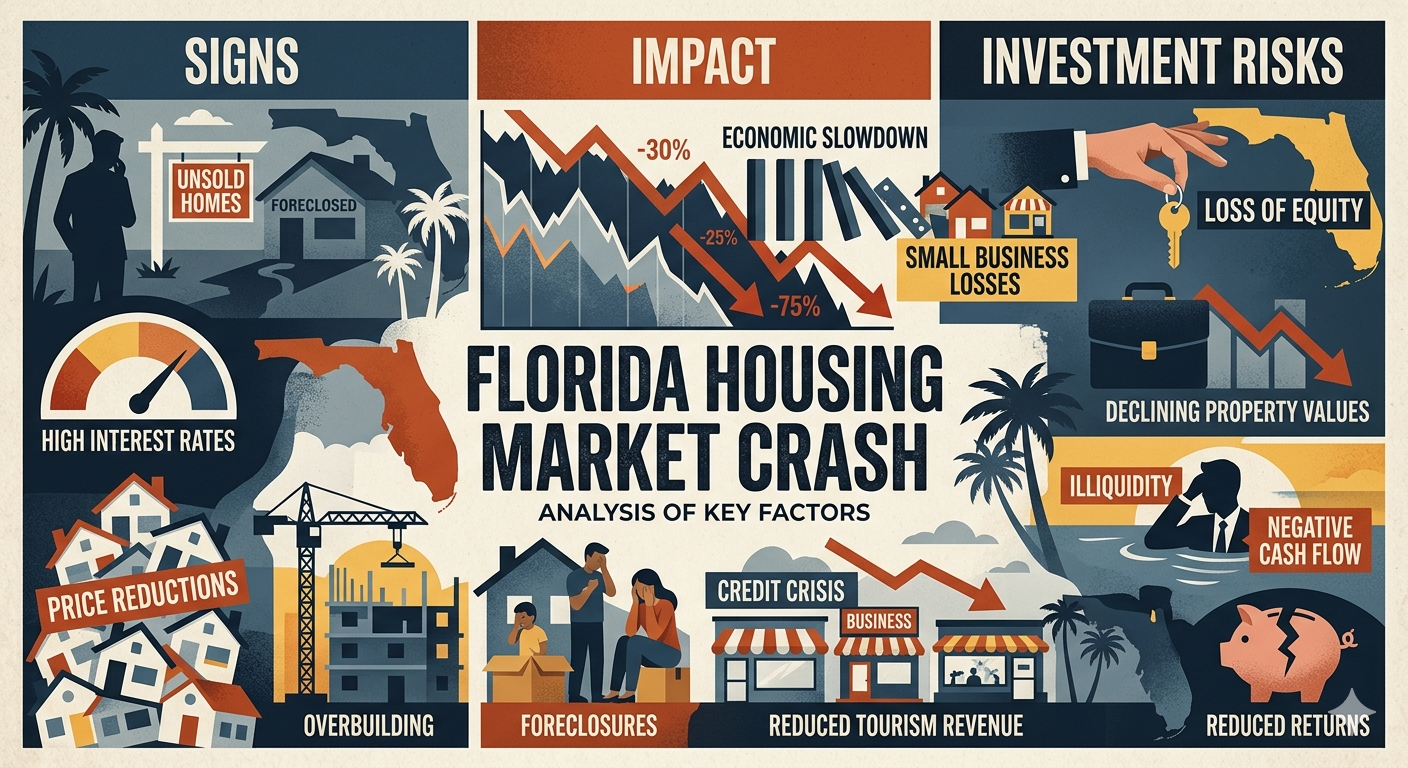
There are several indicators that analysts monitor when evaluating whether a florida housing market crash may be developing.
One major sign is declining home sales volume. When fewer people are buying homes, it can indicate reduced demand or affordability issues.
Another signal is rising inventory levels. If more homes are listed for sale but not being purchased, it suggests that supply is exceeding demand.
Price reductions on listings are also an important indicator. When sellers start lowering asking prices consistently, it can reflect weakening market conditions.
Additionally, increased mortgage rates reduce buyer purchasing power, which can slow down demand and pressure prices downward.
Finally, investor activity plays a role. If investors begin selling large numbers of properties, it may increase supply and accelerate price corrections.
While these signs do not guarantee a crash, they are closely watched by economists and real estate professionals.
Impact of Interest Rates on Florida Real Estate
Interest rates are one of the most influential factors affecting the housing market. When rates are low, borrowing is cheap, which increases demand for homes. When rates rise, borrowing becomes more expensive, reducing affordability.
In recent years, rising interest rates have significantly impacted Florida’s housing market. Many potential buyers have been priced out due to higher monthly mortgage payments.
This slowdown in demand can contribute to fears of a florida housing market crash, especially in high-priced areas where affordability is already stretched.
However, higher interest rates do not automatically lead to a crash. Instead, they often result in market cooling, where price growth slows or stabilizes rather than collapsing.
Insurance Costs and Climate Risks in Florida
One unique factor affecting Florida’s housing market is insurance costs. Due to hurricanes, flooding risks, and climate-related concerns, homeowners in Florida face some of the highest insurance premiums in the United States.
Rising insurance costs make homeownership more expensive, which can reduce demand. In some cases, insurance companies have even reduced coverage availability in high-risk areas.
This has raised concerns about long-term stability in certain coastal regions, contributing to speculation about a florida housing market crash in vulnerable zones.
However, while insurance challenges affect affordability, they tend to create localized pressure rather than a statewide collapse.
Migration Trends and Housing Demand
Population growth has been a major driver of Florida’s housing demand. People continue to move to Florida from other states, which supports long-term real estate stability.
Cities like Miami, Tampa, and Orlando remain attractive due to job opportunities, lifestyle benefits, and tax advantages.
Even if migration slows slightly, Florida still maintains strong inbound population flow compared to many other states.
This continued demand is one reason many experts believe a full florida housing market crash is unlikely. Instead, they expect moderation rather than collapse.
Investor Activity and Market Volatility
Real estate investors play a significant role in Florida’s housing market. Many properties are purchased as rental investments, vacation homes, or short-term rental units.
When investor demand is strong, prices tend to rise quickly. However, if investors begin to exit the market due to lower rental returns or economic uncertainty, supply can increase rapidly.
This shift can create short-term volatility and contribute to fears of a florida housing market crash, especially in areas heavily dependent on short-term rentals.
Platforms like Airbnb have also influenced housing demand in popular tourist cities, sometimes reducing long-term rental availability and increasing prices.
Is a Florida Housing Market Crash Really Likely?
While there are warning signs of cooling and adjustment, most experts do not predict a complete florida housing market crash. Instead, the market appears to be transitioning from rapid growth to a more balanced phase.
Several factors support market stability, including continued population growth, limited housing supply in desirable areas, and long-term demand for Florida real estate.
However, certain segments of the market may experience price declines, particularly overvalued areas or regions heavily dependent on speculative investment.
In simple terms, Florida is more likely to experience price corrections and stabilization rather than a full-scale collapse.
Impact of a Potential Market Downturn on Homeowners
If a significant florida housing market crash were to occur, homeowners could face several challenges.
One major risk is negative equity, where mortgage balances exceed home values. This can happen if prices drop sharply after a purchase.
Homeowners may also experience reduced refinancing opportunities, making it harder to adjust mortgage terms or access home equity.
In severe cases, foreclosure rates could increase if economic conditions worsen.
However, current market fundamentals suggest that any downturn would likely be gradual rather than sudden, giving homeowners time to adjust.
Investment Risks in the Florida Housing Market
Investors considering Florida real estate should be aware of potential risks, even without a full florida housing market crash.
High purchase prices combined with rising interest rates can reduce rental yields. Insurance and maintenance costs also impact profitability.
Market saturation in certain areas, especially short-term rental markets, can lead to reduced income potential.
However, Florida still offers long-term investment opportunities due to population growth and tourism demand. The key is choosing the right location and investment strategy.
Diversification and careful market analysis are essential for minimizing risk.
Final Thoughts on the Florida Housing Market Crash Debate
The conversation around a florida housing market crash reflects growing concern about affordability, interest rates, insurance costs, and rapid price growth in recent years. While the market is clearly cooling compared to its peak, most evidence suggests stabilization rather than collapse.
Florida remains one of the most attractive real estate markets in the United States due to its population growth, economic activity, and lifestyle appeal. However, investors and homebuyers should approach the market carefully, paying attention to local trends rather than assuming statewide outcomes.
In conclusion, while risks exist, the idea of a dramatic crash is less likely than a gradual normalization of prices and demand.